- Sleep and mental health are closely related
- 25% of depressed people have obstructive sleep apnea
- Depression can cause fragmented sleep
- Consistent sleep and exposure to light can help boost mood and sleep quality
- Power naps are beneficial
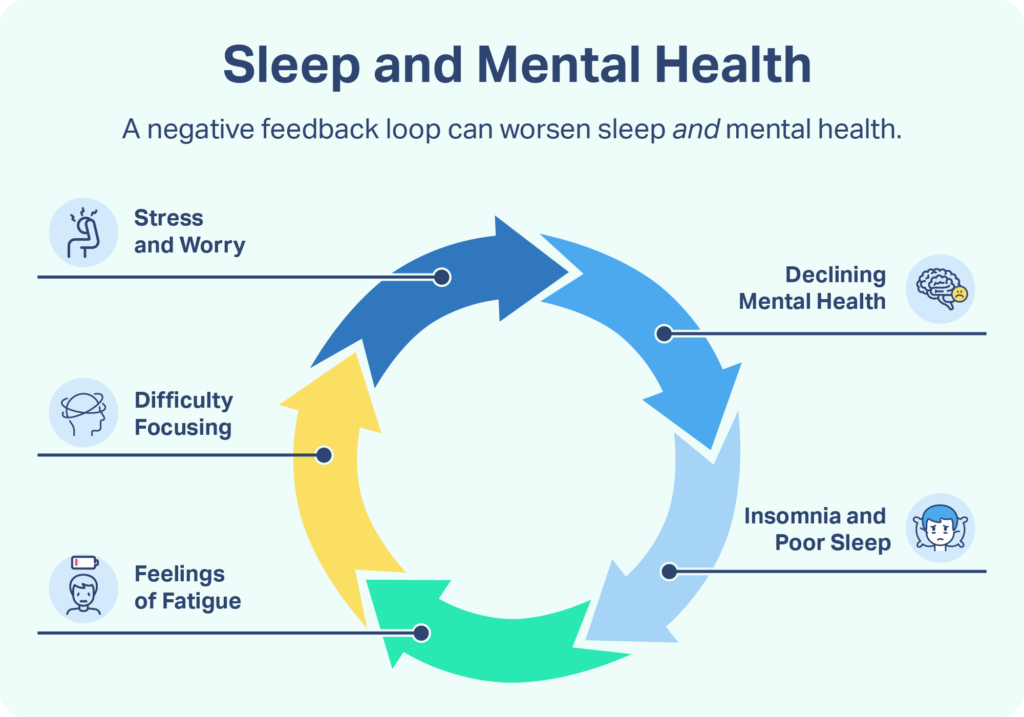
- Anxiety and sleep work in a cycle
Sleep is connected to our mental health. In fact, most people with depression have sleep issues. Sleep and mental health have a bidirectional relationship, meaning that poor sleep contributes to development of depression, whereas depression makes sleep issues more likely. The two have a complicated relationship, and it is hard to tell which comes first. What we do know, however, is that sleep problems such as insomnia, hypersomnia, and obstructive sleep apnea are typically associated with depression. Research has found out that 20% of depressed people have obstructive sleep apnea and 15% have hypersomnia, corroborating this point.
Sleep issues are speculated to affect sleep quality by influencing the function of serotonin, a neurotransmitter that contributes to depression. Sleep disruptions (poor sleep) can affect the body's stress system and circadian rhythms. It also increases vulnerability for depression. As a result, sleep problems can contribute to depression. Additionally, sleep problems can increase risk of initially developing depression. Persistent sleep issues also increase risk of relapse of depression. In many cases, depression causes fragmented sleep, making depressed individuals more sleepy and fatigued during waking hours. Depressed individuals are recommended to sleep at least 7 hours for good health.
What are some healthy habits that can help sleep better, boost our moods, and decrease symptoms of depression? The answer comes down to four essential parts. Firstly, having a consistent sleep schedule is a must-do. Ensuring 7 hours of sleep everyday can be helpful. Secondly, napping carefully is important. Many individuals do not consider how long they should nap for a healthy schedule; most simply nap based on their level of fatigue, believing this is the most healthy way. Naps during the day are often caused by restless or inconsistent sleep. Although napping for a long time may seem enticing, they can interfere with the ability to sleep during the night. Consequently, researchers recommend individuals to take "power naps" that last for 10 to 20 minutes. These naps help regulate emotions, reduce sleepiness, and lead to better performance. Naps longer than 20 minutes can limit the ability to sleep in the evening, and those shorter than 10 minutes are not long enough to gain the benefits of napping.
Thirdly, going outside is helpful. Exposure to sunlight aligns the body's internal clock and circadian rhythms. As the sun sets, the body produces melatonin to induce sleepiness and promote sleep. That is why exposure to the outside environment can foster a good night's sleep. Lastly, exercising regularly is beneficial. As mentioned earlier in this web page (refer to section "Lifestyle Habits and Sleep Quality" for more info), the mechanism behind how exercise results in good sleep is a mystery. However, researchers have observed that those that engage in exercise report good sleep quality. Regular exercise been found to greatly decrease symptoms of depression.
Anxiety and sleep are also connected to one another. They often work in a cycle, and the pattern affects both mood and concentration and sometimes even long-term health issues. Anxiety is more common than you might think. Indeed, anxiety disorders are the most common type of mental illness, with 20% of American adults being diagnosed with it. It often involves worry and unease. So how does it relate to sleep? To begin with, serious sleep disturbances are symptoms of anxiety disorders. The logic is simple: people with worry tend to worry in bed, leading to sleep disruptions. Insomnia (State marked by worry that is caused by mental hyperarousal) is a common symptom of these disorders.
Anxiety about going to sleep can disrupt sleep as well. Negative thoughts about going to bed (this is a type of "anticipation anxiety") create challenges to healthy schedules and routines. Such anxiety and pre-sleep rumination may affect vivid dreaming during REM sleep, provoking nightmares and ultimately disrupting sleep. These nightmares can also exacerbate the fear of going to sleep and eventually compound the negative effect on sleep. As mentioned, anxiety and sleep are connected in the opposite cause and effect relationship as well. People with obstructive sleep apnea, for example, have higher rates of mental health problems. These problems include depression, anxiety, and panic disorders.
Let's now learn about methods to treat these anxiety disorders. Firstly, improving sleep hygiene can help combat them. Better sleep can help fight anxiety. Hence, healthy sleep habits and a consistent schedule are important. Creating a more comfortable sleep environment by eliminating sources of sleep disruption can also foster good sleep. Additionally, avoiding caffeine and alcohol in the evening is a must. Secondly, relaxation strategies can be used to treat the disorders. Relaxation exercises such as deep breathing or mindfulness meditation sessions can break the cycle. Scheduling time to actively worry can also eliminate time spent worrying when going to bed.
Thirdly, color noise can be used. There are a myriad of options for color noise and the selection depends on your preference. White, pink, and brown noise are some of the most common ones. White noise is consistent across all frequencies and can thus obscure various sounds in the environment. Pink noise is softer and naturally balanced and is perceived as more calming to some. Brown noise, on the other hand, emphasizes lower frequencies and can be soothing for anxiety. If you are considering using color noise to sleep. It is recommended that you experiment and find out what works best for you personally.
Curiously, many individuals find that their anxiety intensifies at night. Hormonal fluctuations, changes in cortisol levels, and relatively quiet environments are attributed to this phenomenon as they make anxious thoughts more noticeable. Collectively, all these factors contribute to worsened sleep. However, just because so many factors contribute to the problem it does not mean we cannot fix it. With the mentioned strategies, it is highly possible to sleep better.