
- Noise
- Higher levels of noise may decrease sleep quality
- Intermittent noises are more disruptive to sleep than continuous noise
- Ambient Temperature
- Optimal temperature ranges exist
- Humidity
- Optimal humidity ranges exist
- Light
- Evening light can significantly affect sleep quality
- Air Quality
- Poor air quality can disrupt sleep and impair breathing
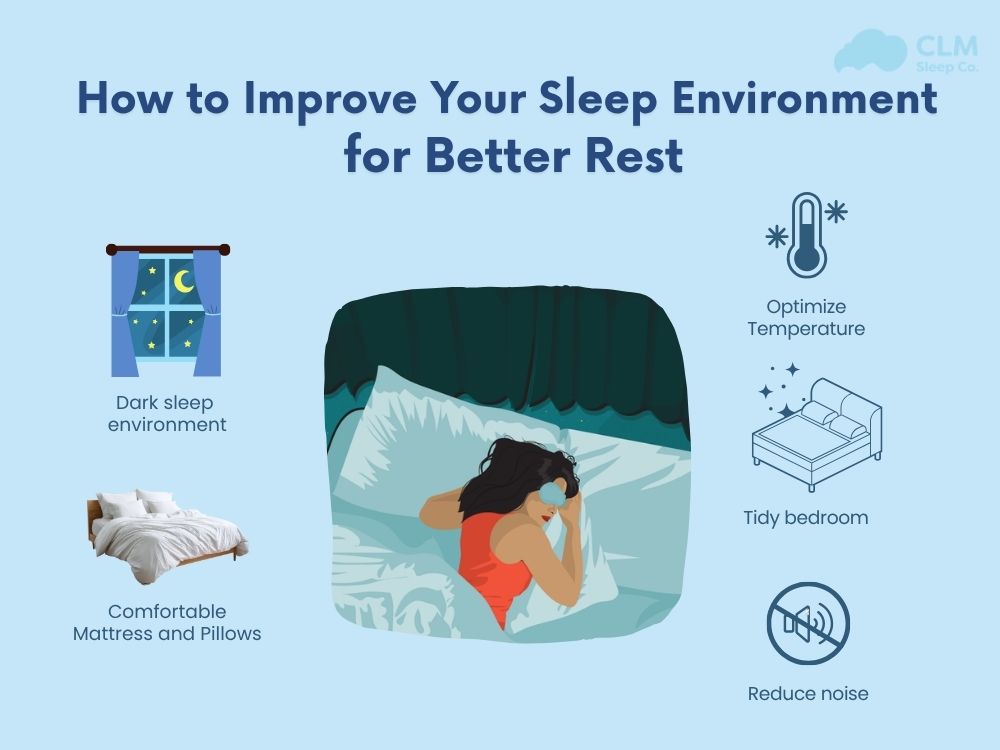
This might not come as a surprise, but your sleep environment can markedly affect your sleep quality. Inappropriate sleep environments can lead to disrupted sleep and reduced sleep quality. As a result, it's important to know what environment is generally best for good sleep and apply the knowledge to your own sleeping area. Main factors that affect sleep quality are noise, ambient temperature, humidity, light, and air quality.
Let's first learn about how noise is connected to sleep. Magnitude of sleep disruption depends on the decibel level (dB), frequency and pitch, duration, and whether the noise is meaningful (e.g., a familiar voice would be meaningful). Research has indicated that higher levels of noise affects duration of sleep stages and increased sleep fragmentation (sleep disruptions). More frequent pulses can cause more sleep disruption as well, though there are large interindividual differences in noise sensitivity. A working group report from the World Health Organization (WHO) on noise determines a casual relationship between nighttime noise exposure and self-reported sleep disturbances and health problems, use of pharmaceuticals, and insomnia-like symptoms. Louder noises are needed to wake individuals from deeper stages of sleep. Overall, findings suggest that quiet environments are better for sleep but that continuous noise may help dampen intermittent noises. In general, individuals perceive intermittent noise as more disruptive to sleep than continuous noise. In fact, exposure to intermittent noises above 35 dB are associated with reduced sleep quality and quantity. As a result, use of continuous white noise can help minimize sleep disruption and be useful for better sleep.
Ambient temperature is also associated with sleep quality. Core body temperature tends to decline during sleep. Such drop in heat production is due to reduction in metabolic rate and heat loss due to inactivity. By contrast, proximal and distal skin temperatures rise during sleep. As a result, during wake and sleep, core and skin temperatures interact and maintain a balance between heat loss and production. Ambient thermoneutrality is the point where ambient air temperature allows for optimal maintenance of the core and temperature. When the core temperature is 36-38˚C and that of skin is 32˚C in the absence of clothing and bedding, ambient thermoneutrality ranges from 27.9-28.5˚C. Ambient temperature above this can lead to an uncomfortable environment and induce sweating. Contrastingly, temperature above this range can cause shivering. When insulation (clothing and blanket) are used, hotter ambient temperatures are more disruptive to sleep than colder temperatures. This is most likely because the insulating material allows individuals to adjust the sleep environment during their sleep. Warmer temperatures within the thermoneutral zone have been discovered to allow for warmer skin temperatures and facilitate sleep onset. Cooler temperatures within this zone can enhance slow wave sleep. However, temperatures either above or below this zone lead to poor sleep quality.
Humidity also plays a role in shaping your sleep. Optimal humidity for human comfort ranges between 40-60%. As humidity levels rise above this, temperatures can feel hotter than they actually are. Similarly, as they fall below, temperatures feel colder. Sleep is negatively affected when humidity levels are outside the optimal range. As a result, maintaining humidity levels in a sleep environment is important. Using a humidifier for dry areas and a dehumidifier in humid areas can help.
Light is another important factor that impacts sleep. Light leads to sleep disruption as it resets the circadian pacemaker. Thus, inappropriately timed light exposure can inhibit sleep onset by shifting the circadian phase. Overall, this can affect sleep on subsequent nights. Research has suggested that evening light exposure as low as 65 lux can shift the circadian phase of melatonin by one hour, when compared to light exposure of 3 lux. Impacts on the circadian rhythm also depend on the intensity of the light. The human circadian pacemaker is most sensitive to short-wavelength light (460-480nm range). Blue light leads to greater melatonin suppression and has significant effects on the phase shift. Unlike blue light, low intensity red light does not suppress melatonin. Exposure to blue light of a high color temperature or narrow bandwidth before bed alters the distribution of slow wave and REM sleep. By contrast, exposure to red light 30 minutes before bed has been associated with improved self-reported sleep quality, shorter sleep latency, and increased sleep duration. Light is also considered an environmental stimulus that causes sleep disruption and nocturnal arousals. Light pollution can disrupt sleep. Overall this information suggests it is important to reduce blue light exposure before bed, increase red light exposure, and avoid light pollution.
Although not always considered, air quality can affect sleep as well. Poor air quality can lead to sleep disruptions and impaired breathing during sleep. Studies indicate that exposure to reduced oxygen and elevated carbon dioxide can disrupt sleep. Poor air quality, cigarette smoke, and room scents have also been associated with lower sleep quality. Oxygen enrichment has been found to increase SWS and reduce apneas among individuals who sleep at altitude. As a result, supplemental oxygen may be useful in mitigating negative effects of sleeping at altitude. Ventilation during sleep is also important for ensuring adequate sleep quality. It is possible that some scents enhance deep sleep, but further research is needed to prove this idea.