
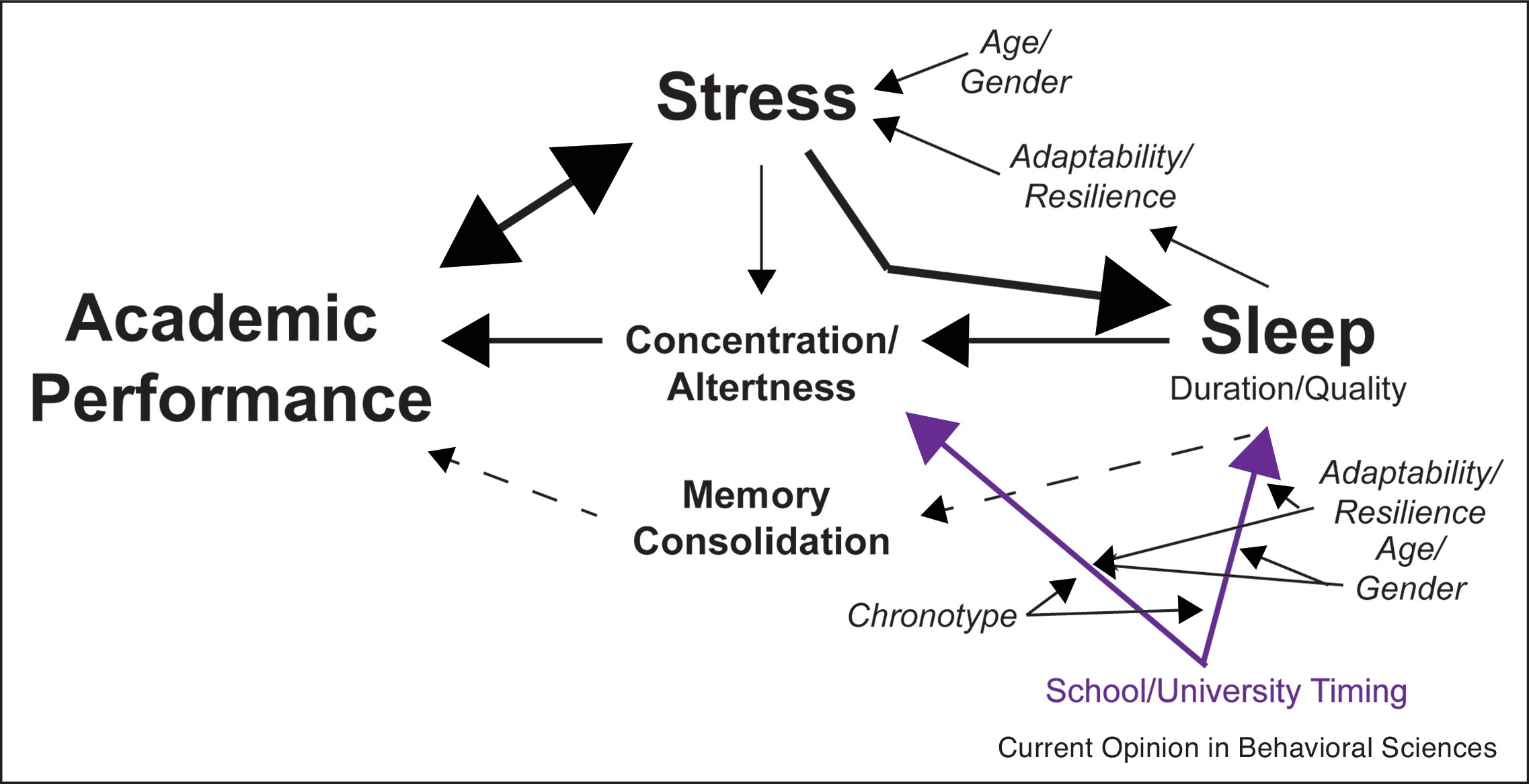
- Memory
- Consolidation of memory involves filtering of information
- Sleep strengthens synaptic connections that were active during awake-periods
- Academic Performance
- Nearly 25% of variance in academic performance is attributed to sleep
- Earlier average bedtime and enhanced quality of sleep positively correlated to higher overall scores
- Long consistency is important for improved academic performance
Do you know that people who sleep more and better often get better grades? In fact, multiple studies have found a correlation between sleep deprivation and academic performance. The 2019 MIT study provided one of the most important insights to this subject. It revealed that nearly 25% of variance in academic performance is attributed to sleep. The study used objective measures of sleep duration and quality to ensure its reliability and produced findings that helped conclude that better quality, longer duration, and greater consistency of sleep correlate with better grades.
The study found that enhanced sleep quality and longer duration led to academic success. Factors such as earlier average bedtime, earlier wake-up time, greater duration of sleep, and enhanced quality of sleep positively correlated to higher overall scores in chemistry class. On the other hand, the study indicated that greater inconsistency in sleep led to lower grades. Students with the routine of sleeping less during weekdays and oversleeping on weekends were, as can be assumed, associated with worse performance. But there are some times when we do not have the luxury of a good, long sleep–like in exam periods.
Does this mean that you will most likely receive lower grades after cramming late the day before? Researchers note this is not necessarily true. Research showed that there was no relation found between the single night before the test and one's performance. The positive correlation was rather more relevant to sleep duration and quality of the month and week before the test. This indicates that long consistency is important for good sleep and improved academic performance.
Furthermore, sleeping well provides cognitive gains. Sleep solidifies memories of the day and can assist with recalling what you studied. Although the exact mechanisms behind the relationship between sleep, memory, and neuro-plasticity are yet unknown, there exists a general understanding. It is that sleep strengthens synaptic connections that were active during awake-periods, ultimately resulting in the consolidation of memory and successful academic performance. When memory consolidation takes place, the brain goes through a process of filtering. The brain consolidates important things while filtering out the unimportant ones. Consequently, without sufficient sleep, the cognitive function suffers and the capacity to learn decreases.. Lack of sleep, on the other hand, leads to poor attention and cognition. Sleep deprivation. Due to the same reason, lack of sleep increases fatigue and sleepiness while worsening cognitive performance. In fact, it is known that the cognitive performance of those who have been awake for 17 hours is equal to one who has a blood alcohol concentration of 0.05%.
As mentioned, sleep is associated with academic performance. Sleep deficit leads to lack of concentration and attention during class. Inconsistency in sleep schedule, also referred to as the social jet lag, negatively correlates with academic performance (Note: Refer to Teen Sleep webpage for more information). Indeed, adolescents with greater sleep inconsistency are found across studies to perform worse than peers who sleep well. A study discovered some interesting gender differences on various factors of sleep and good sleep quality. For instance, sleep inconsistency and quality significantly correlated in both males and females but stronger in males. This indicates that males need to pay more attention to long-duration sleep for a good night's sleep.