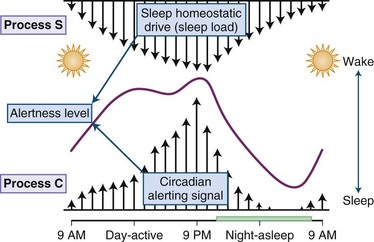
- Circadian Rhythm: Process C
- Regulates sleep/wake cycle
- Reponds to light change in environment
- Clocks in our bodies
- Homeostatic Sleep Drive: Process S
- Sleep pressure increases when you are awake longer
But what regulates the sleep/wake cycle in the first place? This is a question that can be answered by the "Two Process Model of Sleep Regulation." In this model, the circadian component is called Process C and the homeostatic sleep/wake component is called Process S. The circadian rhythm is a 24 hour internal clock in our brain. This system regulates cycles of alertness and sleepiness (sleep/wake cycle) and responds to light changes in the environment. Indeed, the system evolves to help adapt to changes in the surroundings, anticipating changes in radiation, temperature, and food availability. The central clock, also known as suprachiasmatic nucleus (SCN), generates and regulates the body's circadian rhythm. Recent discoveries have revealed, however, that there are also secondary clocks in organs (including the heart, liver, kidneys, lungs, intestines, skin, lymphocytes, esophagus, spleen, thymus, adrenal gland, prostate, and olfactory bulb) that support the system. These organs are independent yet still synchronized with the SCN as well as other factors such as temperature and timing of meals.
Overall, the circadian rhythm is a biological clock that optimizes environmental adaptation, energy utilization, and tissue repair. The system integrates hormonal, metabolic, and immune systems to adapt to the environmental periodicity. It regulates the synthesis and activity of hormones, neurotransmitters, metabolites, and immunomodulators–all while ensuring that cellular processes are synchronized with environmental signals. The circadian rhythm is important as the sleep/wake cycle helps replenish and heal the body, allowing for proper functioning. Proper sleep allows the body to engage in circadian rhythms. In turn, circadian rhythms build energy stores that can be used for metabolic processes, neuronal remodeling for synaptic function, memory consolidation, and assimilation of complex motor systems. Such organism-wide homeostasis allows for precise temporal coordination (process of aligning actions) and functional output from the network of clocks.
Let us learn more about the importance and role of SCN in particular. SCN is located in the hypothalamus in the brain. As the central clock, the SCN sets the pace for circadian rhythms. Light is detected by the eyes through specialized retinal ganglion cells, which send signals through the optic nerve. The light signal passes through the retinohypothalamic pathway and activates the SCN. The activated SCN releases GABA, an inhibitory neurotransmitter, which in turn inhibits the paraventricular nucleus (PVN). The inhibition of PVN prevents signals from travelling through the intermediolateral nucleus and the superior cervical ganglion, and the sympathetic nervous system is made inactive. The pineal gland needs sympathetic stimulation to release melatonin. As a result, when there is no sympathetic signal, no melatonin is secreted. This shows how light signals are processed by the SCN to regulate the secretion of melatonin, a hormone that induces sleep. This allows SCN to regulate sleep.
On the other hand, the homeostatic sleep drive is a process based on the idea of "sleep pressure." It is seen as a process independent of circadian timing and largely surrounds the concept that longer awake time increases sleep pressure whereas sleep dissipates it. Typical physiological markers for "sleep pressure" include slow wave activity observed through the EEG and SWS. Generally, SWA is high at the beginning of the nocturnal sleep episode when sleep pressure is greatest. By contrast, SWA exponentially declines across the night's NREM episodes as sleep lowers sleep pressure. The two systems, circadian rhythm and homeostatic sleep drive, interact to determine the timing, depth, and duration of sleep. However, how this happens is not yet fully understood.