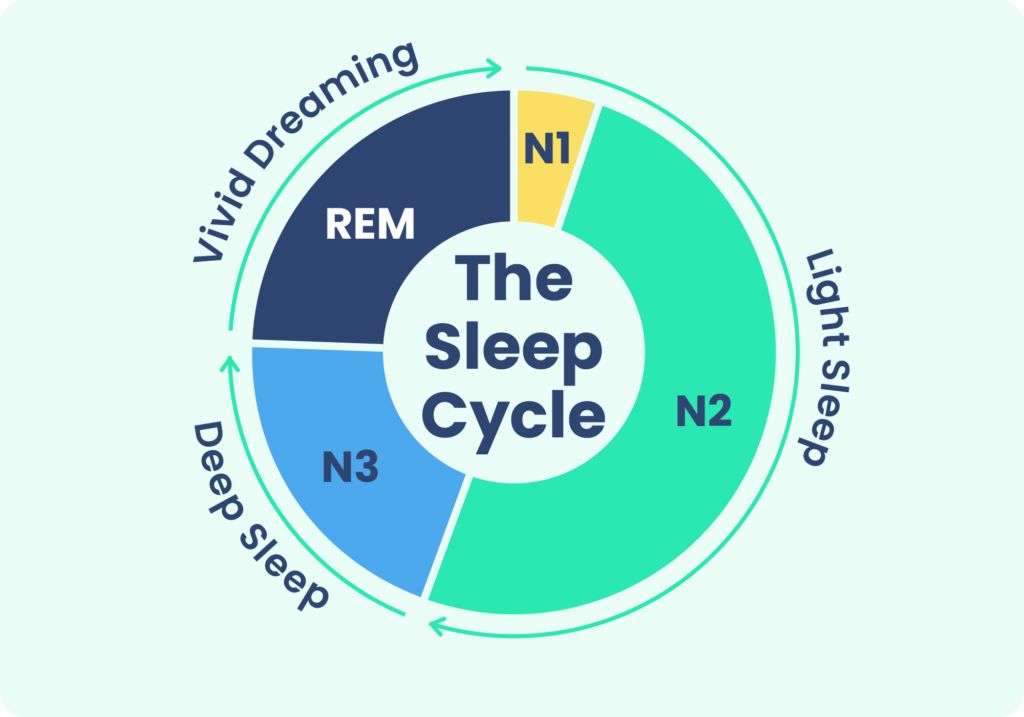
- NREM: No rapid eye movements
- N1: Between sleep and wake, easy to wake up
- N2: Subdued state
- N3: Deep sleep, hard to wake up
- REM: Rapid eye movements
Let us first learn about the stages of sleep. It's important to make distinctions between the stages to know what really happens while sleeping. There are four stages of sleep, and they can be categorized into two big groups: non-rapid eye movement (NREM) and rapid eye movement (REM) sleep. As the names suggest, NREM sleep is when eye movements are absent. Stages in this category are characterized by a dominating parasympathetic nervous system and slow regular heart and respiratory rates. REM sleep is when bursts of rapid eye movements take place. There is an absence of muscle tone, and stages in this category are characterized by a dominating sympathetic nervous system and fast irregular heart and respiratory rates. NREM sleep consists of three separate stages (N1, N2, and N3) while REM is considered as one. The differences between the stages are distinct brain wave patterns, eye movementment presence or absence, and degrees of muscle tone.
N1 is the transition between wakefulness and sleep. In this stage, the body has not fully relaxed yet, and one's body and brain activities just start to slow down. One can wake up easily by an external stimulus (referred to as low arousal threshold) as it is considered the lightest stage. However, if there are no interruptions, individuals quickly move on to N2. During N2, one is in a subdued state. In this state, one's body temperature generally goes down, while muscles relax and the heart rate and breathing slow down. In this stage, polysomnographic measures (polysomnography: diagnostic es that records physiological responses during sleep) indicate frequent bursts of low-voltage, fast frequency EEG waveforms (spindles) and high-voltage, slow-frequency EEG spikes (K-complexes). Normally, half of one's entire sleep is spent in N2.
N3, also known as deep sleep or slow wave sleep (SWS), is when it becomes harder to wake up (referred to as high arousal threshold). During N3, one's muscle tone, pulse, and breathing rate decrease, and the brain activity exhibits an identifiable pattern. These detectable patterns are delta waves, which gives N3 its other name of "delta sleep." N3 is considered very important for restorative sleep as it fosters body recovery and growth. Individuals spend most time in N3 during the first half of the night, and the N3 stages get progressively shorter as one continues sleeping (REM sleep decreases overall). Overall, NREM is characterized by minimal mental activity and a movable body.
REM sleep is when rapid eye movements occur and muscle twitches are present. During REM, the body experiences atonia (temporary muscle paralysis), with the eyes and muscles being exceptions to this–they move rapidly. In this stage, brain activity picks up and gets closer to what it is like when one is awake. For this reason, many experts associate REM with vivid dreams, stating that the increase in brain activity explains the presence of dreams. While they agree that dreams can happen in any sleep stage, they are more common and intense in REM episodes. This stage is believed to be crucial for cognitive functions such as memory as well. Overall, REM is characterized by eye movements and absence of muscle tone.
NREM and REM sleep continue to alternate through the night as a cycle. REM sleep episodes typically become longer across night while NREM becomes shorter. An average NREM-REM sleep cycle is approximately 90-110 minutes, while the first is shorter, being 70-100 minutes. In the first cycle, 1-7 minutes are started with N1 sleep. In this stage, sleep is easily discontinued due to a low arousal threshold. Throughout the night, transitional stages occur in this stage. Severely disrupted sleep is often marked by an increase in occurrences/percentages of N1 sleep. The next 10-25 minutes are spent in N2 sleep. Compared to N1 sleep, the arousal threshold is higher, so individuals need more stimuli to wake up. In this stage, high-voltage slow waves start to appear and eventually lead to N3 sleep.
The following 20-40 minutes are spent in N3 sleep. This stage is classified by more than 50% high voltage slow wave activity in EEG activity. Lastly, REM sleep takes place for under 10 minutes. During this stage, the arousal threshold is variable. Some researchers have theorized that arousal stimulus is incorporated into the ongoing dream story rather than waking the individual up. The percentages of each sleep is as follows: N1 2-5%, N2 45-55%, N3 (SWS) 10-20%, and REM 20-25%. During adolescence, there is a quantitative change in SWS. SWS decreases by about 40% even if the nocturnal sleep is constant.